Cart
0
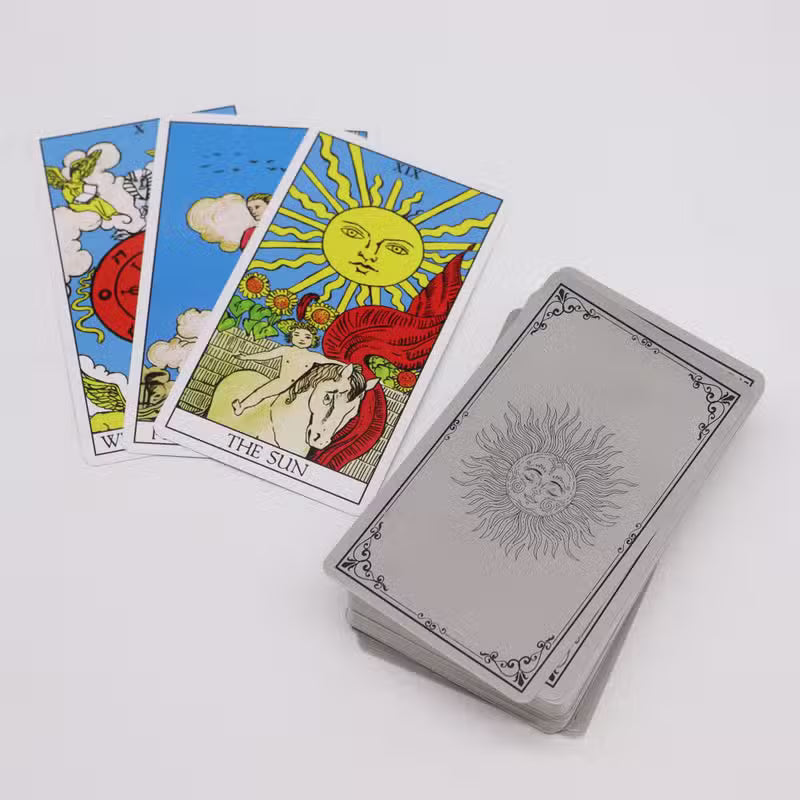
Good tarot questions give you something specific to explore and room to choose a response. Start with the situation, ask about an aspect you can influence and finish with a useful focus such as a next step, an assumption or a conversation. “What could help me prepare for this conversation?” is easier to work with than “What will happen?”
This guide includes a question-writing method, 30 practice prompts and examples of how the wording changes a reading. You can also use our interactive question builder to create a starting prompt for your own situation.
How do you write a useful tarot question?
Use three ingredients: a situation, a focus and a scope. The situation names what you want to explore. The focus gives the reading a job. The scope keeps the question small enough to reflect on without trying to answer everything at once.
Situation: I am starting a creative project.
Focus: What would help me begin?
Scope: The first practical step this week.
Finished question: “What could help me take the first practical step on this creative project this week?”
- Name the situation plainly. Write one sentence about something you are experiencing. Avoid combining several unrelated subjects.
- Choose one job for the reading. Decide whether you want to explore an action, a resource, a perspective or a conversation.
- Keep your own agency visible. Ask about what you can notice, clarify or try.
- Set a manageable scope. A particular task or conversation often gives a clearer starting point than your entire future.
- Check the wording aloud. If you cannot explain what the question is asking, simplify it before drawing.
The scope sets the subject of your reflection. It does not make a reading a reliable forecast of what will happen within that period.
Tarot question examples: before and after
| Starting wording | A useful rewrite | What changes? |
|---|---|---|
| Will I succeed? | What could help me make progress on the next stage? | Defines something to work on. |
| Does this person like me? | What can I clarify in how I communicate with this person? | Focuses on your communication. |
| Which choice is right? | What should I consider before choosing between these options? | Invites comparison rather than a verdict. |
| Why does everything go wrong? | Which part of this situation deserves my attention first? | Replaces a sweeping claim with a specific focus. |
| When will inspiration arrive? | What could make space for a small creative experiment? | Suggests an action you can try. |
| Will tomorrow be difficult? | What support could help me approach tomorrow thoughtfully? | Explores preparation. |
Keep the original wording in your journal if it explains what you were feeling. Then write the version you actually use. Comparing the two can show whether the question became clearer or simply longer.
30 tarot questions for beginner practice
Choose one prompt and adapt it to an ordinary situation. These are original practice questions, so you can change the wording to make it sound like you.
Daily reflection
- What deserves my attention today?
- What assumption could I examine before acting?
- What small action would make today feel more considered?
- Where could I make room for a pause?
- What did I learn from an experience I keep thinking about?
Learning and creative work
- What could help me begin this project?
- Which skill would be useful to practise next?
- What is distracting me from a manageable first step?
- What could I try before deciding that an idea will not work?
- What feedback would help me improve this piece of work?
Communication and relationships
- What could I express more clearly in this conversation?
- What am I assuming that I could ask about directly?
- How could I listen more carefully?
- What boundary would help me communicate respectfully?
- What part of my response is within my control?
Choices and changes
- What matters most to me in this choice?
- What information should I gather before deciding?
- What am I overlooking in option A?
- What am I overlooking in option B?
- What small experiment could help me understand the options?
Practical routines and resources
- What could help me organise this task?
- Where could I ask for useful support?
- Which commitment needs a clearer limit?
- What resource do I already have that I could use differently?
- How could I make this routine easier to repeat?
Reviewing a reading
- Which picture detail shaped my first interpretation?
- What is another reasonable way to read this card?
- How did the spread position change the meaning?
- What happened when I tried the action I wrote down?
- What would I like to practise in my next reading?
How does the question change a one-card reading?

Imagine drawing The Hermit. Begin with what you can see: a figure holds a lantern and a staff. A possible theme is taking time to reflect. Now give that theme two different questions.
| Question | Possible connection | Action to test |
|---|---|---|
| What could help me prepare for a conversation? | Make space to identify what I want to say. | Write my main point before the conversation. |
| What could help me study this week? | Try a quieter setting for focused attention. | Schedule one short session without interruptions. |
The image did not change. The question gave the reflection a different context. Write down the link between them so you can see how you reached the interpretation. A word such as “solitude” becomes more useful when you explain what it might look like in the situation.
Can you ask tarot yes-or-no questions?
You can choose a yes-or-no reading method, but it gives you less room to explore reasons and alternatives. For this beginner course, practise converting a binary question into one about preparation, information or action.
For example, “Should I join this class?” can become “What should I consider before joining this class?” You can then list the practical information you still need, such as the schedule, cost and subject coverage, and check it directly. Use the reading to reflect on your priorities while gathering the facts needed for the decision.
Try a five-minute question-writing exercise
- Write the question that first comes to mind.
- Circle any part that asks you to know another person’s private thoughts or predict an exact outcome.
- Choose one focus: next step, support, perspective, communication or learning.
- Rewrite the question using that focus and one specific situation.
- Read it aloud and remove any words that do not make it clearer.
Try the question builder in the learning hub for a starting sentence. It offers a writing scaffold; adapt the result before using it. You can then follow the one-card walkthrough and record the question exactly as you asked it.
What if you want to ask the same question again?
First reread the original entry. Has the situation changed? Is there a new piece of information or a different focus? If you are drawing again because the first card was uncomfortable, write that reaction down before choosing another card.
A useful follow-up can explore the first reading: “What did I assume when I saw that image?” is different from repeating the same question until a preferred card appears. Keep the question and draw count in your journal so you can review the process honestly.
Frequently asked questions about tarot questions
What is a good first question to ask tarot?
Try “What deserves my attention today?” or choose a small situation and ask what could help you approach it thoughtfully. Keep the first reading to one card.
Does every tarot question need to start with “what”?
No. “How could I communicate more clearly?” and “Where could I ask for support?” can also work. The useful part is the focus and scope.
How specific should a tarot question be?
Specific enough that you know what the reading is exploring. Name one task, conversation or choice, while leaving room for more than one reflection.
Can I ask about another person?
You can explore your own part in a relationship or conversation. Questions about communication, assumptions and boundaries give you something you can check through your own actions.
Should I change the question after drawing?
Keep a record of the original question. If you realise it was unclear, note that and write a revised version separately, so the question and interpretation do not silently change together.
Can I use these prompts with three cards?
Yes. Give the positions distinct jobs before drawing. For example, use Situation, What to notice and Next step. See the three-card spread guide.
Continue learning
Once your question is clear, learn how to connect two or three tarot cards. For a structured routine, return to the seven-day beginner plan.
Learning notes and image credit
The question-writing framework, prompt bank and worked examples are Arts & More’s original practice material. Interpretations are possibilities to explore in context. The historical card illustration is by Pamela Colman Smith, via Wikimedia Commons; see A. E. Waite’s The Pictorial Key to the Tarot for the accompanying historical tradition.


 https://artsandmore.co.uk