Cart
0
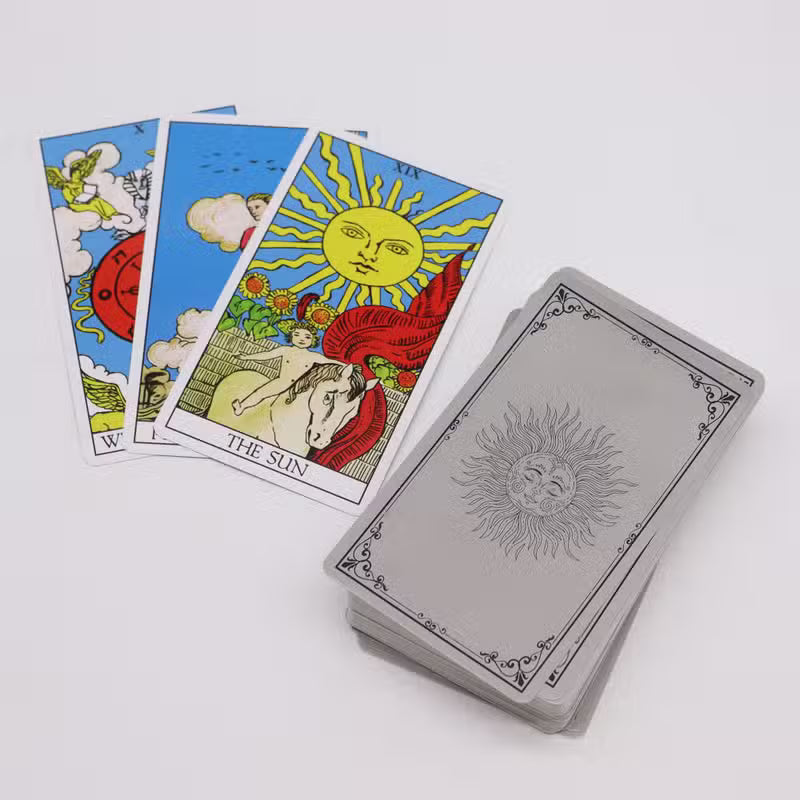
To start learning tarot, practise one small skill each day: recognise the deck’s structure, notice the pictures, ask a useful question, read one card, compare two cards and then try a three-card spread. This seven-day plan gives you a first routine in around 10–15 minutes a day. You can spread the sessions over several weeks if you prefer.
By the end, aim to explain a simple reading in your own words and write down one practical reflection. Seven days is a starting point for practice; confidence comes from returning to the cards and checking your observations.
What do you need to learn tarot?
Use a tarot deck with a guidebook, a notebook and enough room to lay out three cards. If you do not own cards yet, use the free 78-card illustrated library for the observation exercises and the practice desk for sample draws. You can view the learning resources without signing up.
The examples here use Rider–Waite–Smith artwork by Pamela Colman Smith. Other traditions and themed editions may change the pictures, titles or numbering, so compare each exercise with your own guidebook. Our examples are prompts for reflection, with room for more than one reasonable interpretation.
Your first week at a glance
| Day | Skill | What to finish |
|---|---|---|
| 1 | Find your way around the deck | Identify a Major Arcana card, a numbered card and a court card. |
| 2 | Observe before looking up meanings | Describe three visible details in one card. |
| 3 | Ask a question you can work with | Rewrite one broad question as an actionable prompt. |
| 4 | Read a single card | Connect a picture detail, a guidebook theme and one action. |
| 5 | Compare two cards | Write what they share and what changes between them. |
| 6 | Read three positions together | Write one sentence connecting all three cards. |
| 7 | Review and choose your next practice | Review an earlier entry and set a manageable routine. |
Day 1: Understand the 78-card deck
A standard tarot deck contains 22 Major Arcana and 56 Minor Arcana. In the Rider–Waite–Smith tradition, the Minor Arcana have four suits: Wands, Cups, Swords and Pentacles. Each suit has Ace to Ten, followed by Page, Knight, Queen and King.
Lay out one card from each group. For instance, choose The Hermit, Three of Cups and Page of Wands. Read the titles aloud, then check where each belongs. The Hermit is a Major Arcana card; Three of Cups is a numbered Minor Arcana card; Page of Wands is a court card.
Your exercise: Find three different examples in your own deck or the library. Record the name and group of each. Leave memorising the meanings for later sessions.
Explore the illustrated deck structure and sorting exercise.
Day 2: Describe a picture before interpreting it

Choose one card deliberately. Spend a minute looking at it before opening the guidebook. Write three observations using ordinary language: “The figure holds a lantern”, “The head is lowered” and “There is open space around the figure”. Keep the visible detail separate from what you think it might suggest.
Now add a possible reflection: the lantern could prompt you to ask what information would help with your next step. Your guidebook may emphasise solitude or careful reflection. Compare that theme with the detail you noticed, rather than replacing your observation with a memorised phrase.
Your exercise: Write two columns headed “What I see” and “What it could suggest”. Add three observations and one possible interpretation. This makes it easier to notice when you have jumped to a conclusion.
Day 3: Turn a broad question into a useful prompt
Start with something you can reflect on or act on. “Will my project succeed?” leaves success undefined. “What deserves my attention before I take the next step on this project?” gives you a subject to explore and a time to act.
| Starting question | Practice version |
|---|---|
| What will happen this week? | What could help me approach this week thoughtfully? |
| What is someone else thinking? | What can I clarify in my next conversation with them? |
| Will I finish everything? | Which part of my workload needs a clearer boundary? |
Your exercise: Write one question about a small, ordinary situation. Underline the part you can influence. If you cannot find one, rewrite the question until it suggests a reflection or next step. Save that question for tomorrow’s one-card reading.
Explore 30 questions and the question-writing method, or build a practice question.
Day 4: Complete your first one-card reading
Write yesterday’s question, mix the cards in a way that feels comfortable and draw one. Use this sequence: picture detail → possible theme → connection to the question → practical action. You can begin with all cards upright to reduce the number of decisions you are making.
Suppose the question is “What could help me prepare for tomorrow’s conversation?” and you draw The Hermit. The lantern is a visible detail; reflection is one possible theme. You might connect those to taking ten quiet minutes to write your main point. That is an action you can try and later review.
Your exercise: Finish a four-line journal entry using the sequence above. If the card feels unrelated, describe it again and consult its guidebook entry once. You can record uncertainty and return to it later.
Follow the illustrated one-card reading walkthrough for a fuller example.
Day 5: Compare two cards without learning a new spread


Choose two cards with the same number, such as Three of Cups and Three of Pentacles. Both scenes involve people together. Their activities differ: one can suggest shared celebration, while the other can suggest collaboration and skill. These are starting interpretations to test against the artwork and your guidebook.
Your exercise: Write one similarity and one difference. Then give each card the same question: “What would help a group project?” One might prompt time to acknowledge progress; the other might prompt a discussion about roles and feedback. The question helps you turn a broad theme into a useful reading.
Day 6: Give three cards three clear jobs
Set the positions before drawing: Situation, What to notice and Next step. Write those labels on paper and place the cards above them. This helps you read each card in context rather than collecting three unrelated keywords.
- Read each position: describe an image detail and a possible theme for that position.
- Compare the pictures: look for a shared suit, repeated object or change in activity.
- Connect them: write one sentence linking the situation, the thing to notice and an action.
For a busy-week question, an illustrative spread of Two of Pentacles, Three of Pentacles and Four of Swords could become: “I am juggling tasks; checking roles with the people involved could help; I will leave a short pause before accepting more work.” This is a worked reflection, not a fixed sentence those cards always produce.
Your exercise: Complete one spread and stop after writing the connecting sentence. Use the illustrated three-card guide to explore the positions in more detail.
Follow the illustrated card-combination examples to practise connecting the cards.
Day 7: Review an entry and choose what to practise next
Return to the entry from Day 4. What did you notice? What action did you choose? Did you try it, and was it useful? Add a short follow-up without rewriting the original entry. Keeping both versions helps you distinguish what you thought at the time from what you understand now.
Choose your next week around the skill that felt least comfortable. If you recognise themes but struggle to connect them to a question, stay with one-card readings. If individual cards make sense but a spread feels fragmented, practise the three positions from Day 6 with different everyday questions.
Your exercise: Schedule three short practice sessions. For each one, record a question, an observation and a possible action. Keep the plan small enough to repeat.
Copy or print your seven-day practice tracker
Print this page using your browser’s print command, or copy this table into a notebook. Tick the final column on paper and keep your fuller journal entries separately. For a blank reading record, use the printable worksheet in the Guidebook Hub.
| Session | Date | One thing I learned | Done |
|---|---|---|---|
| 1 · Deck groups | ________ | ________________________ | □ |
| 2 · Picture details | ________ | ________________________ | □ |
| 3 · Question | ________ | ________________________ | □ |
| 4 · One card | ________ | ________________________ | □ |
| 5 · Compare two cards | ________ | ________________________ | □ |
| 6 · Three positions | ________ | ________________________ | □ |
| 7 · Review | ________ | ________________________ | □ |
Frequently asked questions about learning tarot
Can I learn tarot in seven days?
You can learn the deck’s basic structure and practise a simple reading in a week. Recognising more cards and interpreting them in different contexts takes ongoing practice. Use this plan as a first routine.
Do I need to memorise all 78 meanings before reading?
No. Start with a card’s picture, write an observation and check its guidebook. Comparing cards and revisiting journal entries gives you repeated contact with the meanings.
Do beginners have to use reversed cards?
You can use upright cards throughout this plan. When you choose to introduce reversals, decide on an approach before drawing and compare it with your deck’s instructions.
Can I use a themed deck for these lessons?
Yes, if you adapt the exercises to its artwork and guidebook. The suits and court names may differ. Check that you can identify the groups before moving to comparisons.
What if a card does not make sense for my question?
Write what you can see and what remains unclear. Check the guidebook, consider the position and leave room for uncertainty. A short, honest entry is useful material for your next review.
Can I start without buying cards?
Yes. Use the illustrated library and sample practice desk for the exercises. If you later want a physical deck, our first-deck guidebook checklist explains what to inspect before choosing.
Continue your tarot learning
Return to the Tarot Guidebook Hub to study a card, use the journal or repeat a practice draw. If you prefer a shorter first session, try Three Days of Tarot Practice. When you are ready to choose physical cards and accessories, the Tarot Kit Finder can help you compare options.
References and image credits
Deck terminology and the illustrated tradition: A. E. Waite, The Pictorial Key to the Tarot (first published 1910), with artwork by Pamela Colman Smith. Card images are historical Rider–Waite–Smith illustrations via Wikimedia Commons. The seven-day curriculum, exercises and worked journal examples are Arts & More’s learning material; interpretations can vary by tradition and context.


 https://artsandmore.co.uk