Cart
0
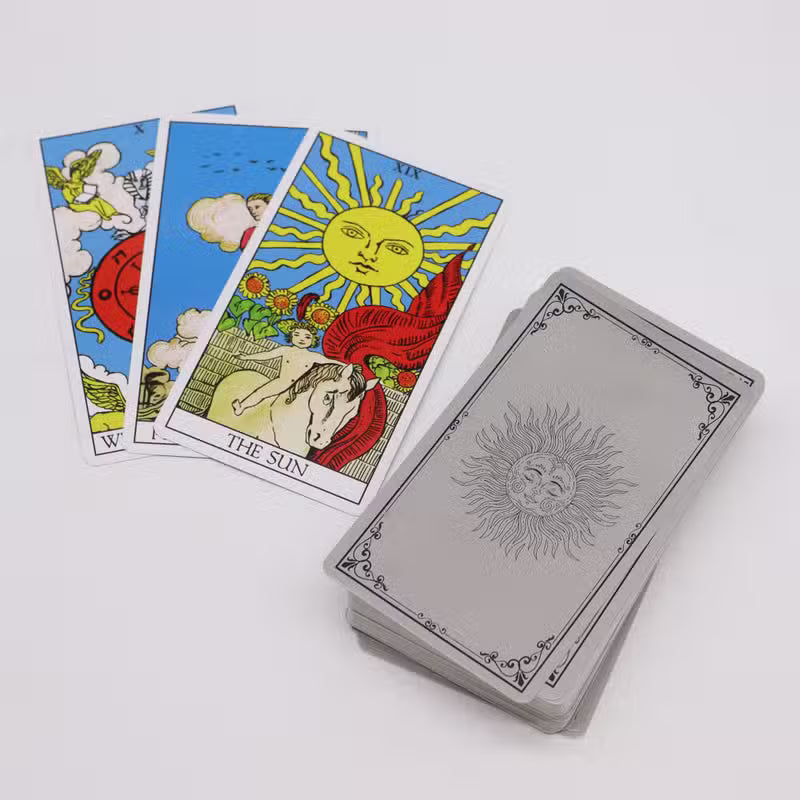
To read tarot cards together, start with the question and spread positions, describe each picture and then connect the cards in one sentence. Look for a shared theme, a contrast or a change in activity. A combination becomes useful when you can explain how the images relate to the question.
This lesson uses illustrated two-card examples and a complete three-card reading. The examples use Rider–Waite–Smith artwork by Pamela Colman Smith and offer possible reflections. Your own deck’s images and guidebook may support different readings.
How do you connect tarot cards in a reading?
- Write the question. Keep it visible so the interpretation stays connected to the subject.
- Label the positions before drawing. “Situation” and “Helpful approach” give two cards different jobs.
- Read each picture. Name a visible detail and one possible theme for each card.
- Compare the cards. Look for something repeated, something different or a possible sequence.
- Write a connecting sentence. Explain how the cards work together and finish with one reflection or action.
A useful sentence frame is: “In this situation, I notice ___; considering ___ could help me ___.” Adapt it to your spread. If you cannot fill it without adding a lot of unsupported detail, return to the question and the pictures.
What should you look for between two tarot cards?
| Connection | What to inspect | Question to ask |
|---|---|---|
| Shared activity | People working, waiting, travelling or gathering | What are these scenes doing similarly? |
| Contrast | Solitude and company, motion and stillness | What does the difference add? |
| Repeated suit | Several Cups, Wands, Swords or Pentacles | Does one area of experience recur? |
| Repeated rank | Two threes or several court cards | How does the rank appear in different settings? |
| Sequence | A possible shift between the positions | What changes as I read the spread? |
One connection is enough for a first reading. You do not have to account for every colour and object. Choose the link that helps explain the question and show which picture details support it.
Two-card example: Two and Three of Pentacles
Question: “What could help me organise a shared project this week?” Set the positions as Situation and Helpful approach before drawing.


Read the first position
Two of Pentacles shows a figure managing two pentacles within a loop. One possible theme is juggling priorities. In the Situation position, you might reflect on switching between tasks or keeping several commitments moving.
Read the second position
Three of Pentacles shows people gathered around work on a building. Collaboration and skill are possible themes. In Helpful approach, this could prompt checking roles, discussing requirements or asking someone with relevant experience for feedback.
Connect the pictures and the question
Both cards belong to Pentacles, giving you a practical starting point. The scene shifts from one figure managing activity to people working together. A connecting sentence could be: “I am trying to keep several tasks moving; a short discussion about who is responsible for each part could make the project easier to organise.”
Action to test: Write the three most immediate tasks and agree an owner for each with the people involved. Record whether that helped when you review the reading.
Try your interpretation before reading another possibility
You might focus on how work is being checked. The first card could suggest continual adjustment, while the second could prompt a planned review rather than reacting to each new request. This is another possible reading if it fits the question and the actual project.
Three-card example: Major and Minor Arcana together
Question: “How could I approach a busy week with more care?” Use Situation, What to notice and Next step. This example shows how a Major Arcana card and two Minor Arcana cards can contribute to one reading.


| Position and card | Visible detail | Possible connection to the question |
|---|---|---|
| Situation · The Hermit | A figure holds a lantern apart from other people. | I may need space to understand what deserves my attention. |
| What to notice · Three of Pentacles | People gather around a piece of work. | Other people’s roles and expertise are part of the situation. |
| Next step · Four of Swords | A figure rests in a still setting. | A deliberate pause could help me respond thoughtfully. |
Connecting sentence: “I need space to identify my priorities; discussing the shared work could clarify what is expected; I will take a short pause and review the plan before accepting another commitment.”
Here The Hermit introduces a broad theme of reflection, while the Minor Arcana offer concrete scenes of work and stillness. That distinction helps you study the groups, but the question and positions give every card its job. The Major Arcana card does not cancel the other cards or prove that a major event is coming.
Action to test: Before agreeing to another task, review the current list and clarify one expectation with the people involved. The following day, note what changed in your understanding.
For the deck’s structure, revisit the Major and Minor Arcana comparison. For other position layouts, see the three-card spread lesson.
Does changing the order change a tarot combination?
It can change the interpretation when the positions have different jobs. Keep the same two cards from the first example, but swap their positions. Three of Pentacles in Situation may describe a project already involving several people. Two of Pentacles in Helpful approach could prompt flexibility in scheduling or a more realistic balance between commitments.
The new sentence could be: “The project involves several contributors; allowing for adjustments in the timetable could help us coordinate.” That differs from using collaboration as the main suggested approach. The images stay the same, but their roles in the spread change.
Try it: Read a pair once in its original positions, then swap the cards deliberately as a study exercise. Label both versions in your journal so the second version is clearly an experiment.
What if the cards seem to contradict each other?
A contrast can be the useful part of a reading. One card may suggest movement while another suggests a pause. Check the positions: a card about the current situation can differ from a card about a possible approach.
For example, an energetic project scene in Situation and a quieter image in Next step could prompt you to consider whether planning time would support the activity. You do not need to force the cards into agreement. Write down the tension and ask how it relates to the question.
A ten-minute card-combination exercise
- Choose an everyday question using our question-writing guide.
- Write two positions: Situation and Helpful approach.
- Draw two cards, or deliberately choose two from the illustrated library for study.
- Record one visible detail and one possible theme for each.
- Find one similarity or contrast.
- Write a sentence connecting both cards to the question.
- Choose an action or a question to check in real life.
Keep a simple journal record: Question / Positions / Cards / Details / Connection / Action / Later review. If you feel stuck, reduce the reading to two cards again. More cards introduce more relationships to interpret.
When should you draw a clarifying card?
First name what is unclear. If you have not decided what the original positions mean, an extra card can add confusion. Return to the question, inspect the pictures and consult your guidebook before drawing again.
If you choose to add a card, give it a clear job, such as “What detail am I overlooking in the Helpful approach position?” Record that question separately. This lesson works with two or three cards, so you can complete it without any clarifiers.
Frequently asked questions about tarot card combinations
Do two tarot cards always have the same combined meaning?
No. The question, positions, artwork and reading approach can change the connection. Explain how you reached the interpretation instead of treating the pair as a fixed phrase.
Should I read each card separately first?
For this beginner method, yes. Describe each card in its position, then compare them. That gives the connecting sentence something specific to build on.
What does a repeated suit mean?
It can invite attention to the themes you associate with that suit. Use the individual images and question to decide whether the repetition is useful to this reading.
Can I combine Major and Minor Arcana cards?
Yes. The worked three-card example above shows a Major Arcana card beside two Minor Arcana cards. Give each card its assigned position and read the whole spread.
Do I need reversed cards to read combinations?
No. Practise with upright cards first if that helps you focus on relationships between the pictures. You can study reversal methods separately.
What if I cannot find a connecting sentence?
Write the separate observations and identify what remains unclear. You can revisit the reading later. An uncertain entry can still show you what to practise next.
Continue your practice
Return to the practice desk and journal, or use Day 5 and Day 6 of the seven-day learning plan. Keep your question visible as you practise.
Learning notes and image credits
The method, example readings and exercises are Arts & More’s original teaching material. They offer reflective possibilities rather than fixed meanings for every draw. Historical card illustrations are by Pamela Colman Smith via Wikimedia Commons. For the accompanying historical text, see A. E. Waite, The Pictorial Key to the Tarot.


 https://artsandmore.co.uk